Skip navigation
Logo: Zenjoy is an AI-first digital product studio based in Leuven. We build meaningful digital products, websites, and mobile applications.

De Wikke

Organic vegetables with a story.

Client
De Wikke / Wonen en Werken

Services
Web application, e-commerce, UX design, cloud architecture, hosting

Sector
Social enterprise / food / short supply chain

Timeline
~3 months (concept to go-live)

Status
In production, actively growing

Tech stack
Nimbu (CMS + e-commerce), Liquid templates, Alpine.js, Bootstrap 5, TypeScript, Webpack, MultiSafepay, Brevo

The question

De Wikke is the organic horticulture project of Wonen en Werken, a social employment company in Heverlee that provides sustainable work for people at a distance from the labour market. On their fields in Herent and Heverlee, near Park Abbey, they grow organic vegetables sold through a short supply chain, including their own farm shop. They also offer subscriptions to staff and students of KU Leuven and the City of Leuven.

Those subscriptions work in a very specific way. Each period, members choose a package formula: small or large vegetable package, fruit, basic package. They pick a collection point on their campus or workplace. Every week, De Wikke staff put the packages together. Volunteers at the collection point welcome the members and tick off who came by.

Before digitalisation, that whole process ran on email, Excel and paper lists. Payments were followed up by hand. The start of every period meant a lot of manual work, and in-between changes were cumbersome.

De Wikke came to us with a clear question: this has to go digital. But it could not become a standard webshop. The combination of periods, package formulas, collection points, roles and organisations did not fit any existing template.

Approach

A domain that does not fit a webshop

During the first conversations it quickly became clear this was no classic e-commerce project, because of the specific workflow logic.

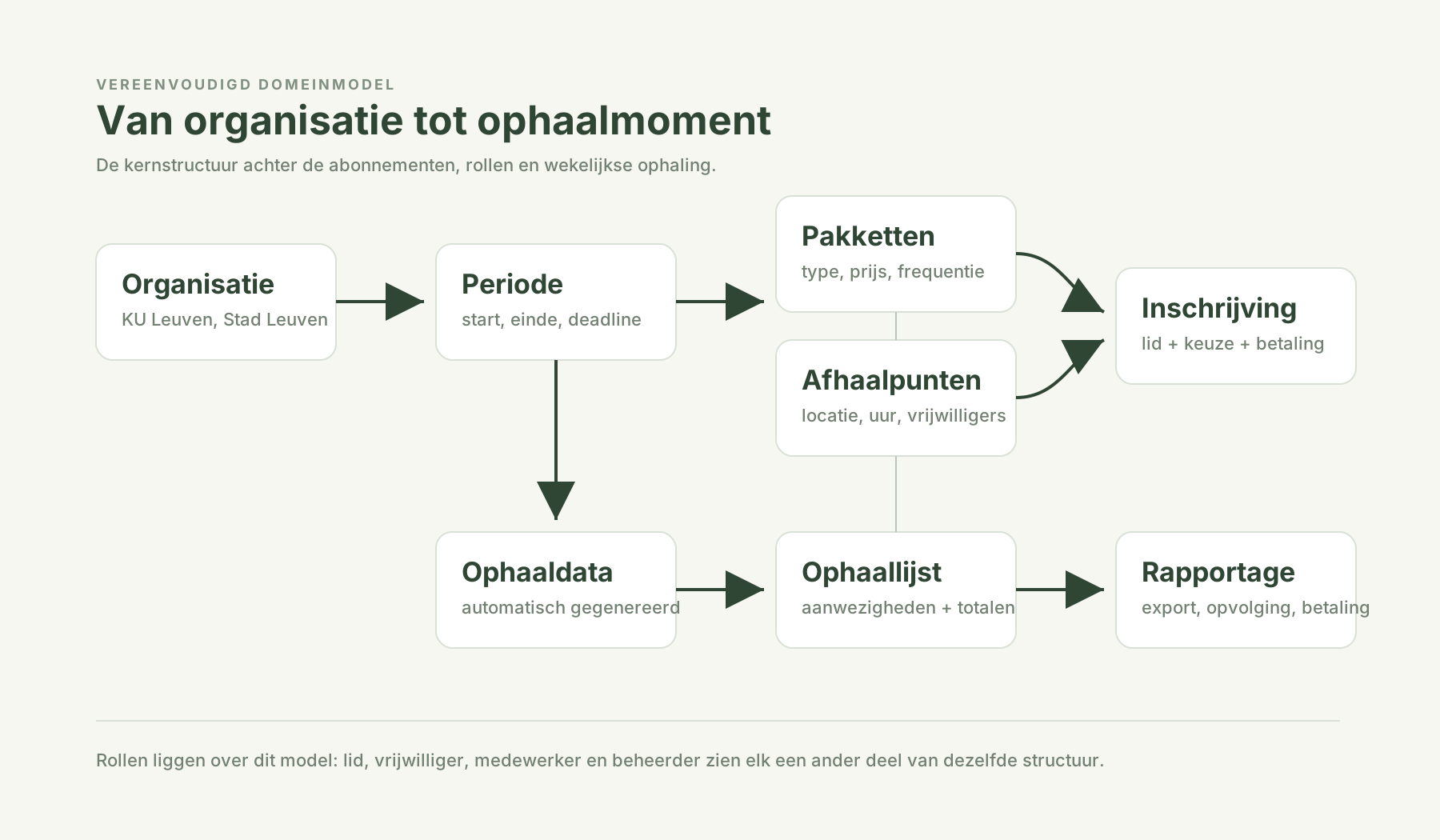
An organisation (e.g. KU Leuven, City of Leuven) has periods. Each period has a start and end date, a registration deadline, available packages, prices and collection points. Within those collection points, volunteers manage the pickups. Members choose their combination of packages and collection point, pay online or by invoice, and get a personal dashboard with their subscription, next pickup moment and package status.

On top of that basic structure sits a layer of roles. A member only sees their own subscription. A volunteer manages the pickup list of their own collection point. A De Wikke staff member oversees all collection points within an organisation. And an administrator has access to everything.

Fifteen entities in the data model, each with their relationships — a standard webshop solution simply would not do.


Nimbu as the foundation

We built the platform on Nimbu, our own CMS with built-in e-commerce. That gave us the control this project needed. Nimbu's content channels let us model the domain completely: organisations, periods, package types, collection points, pickup dates, registrations. Each with their own fields and relationships, exactly as the domain required.

On the frontend we worked with templating for the pages and Alpine.js for the interactive components. Package selectors with running totals, checkbox lists for volunteers, filters on the dashboards. No frontend framework overkill. Exactly enough for what was needed.

The server-side logic runs on Nimbu Cloud Code. Webhooks on orders, a cron job that follows up unpaid subscriptions, a cloud job that automatically generates pickup dates based on a period's configuration. That last one saves the coordinator a lot of manual planning at the start of every period.

Four dashboards, four perspectives

The registration form is the entry point. But the heart of the platform is what comes after.

Member dashboard

The member dashboard shows the current subscription: which packages, which collection point, when the next pickup moment is. Members can change their collection point (up to a set deadline before the next pickup) and manage their newsletter preferences. They can also download invoices and review their orders from previous periods.

Volunteer dashboard

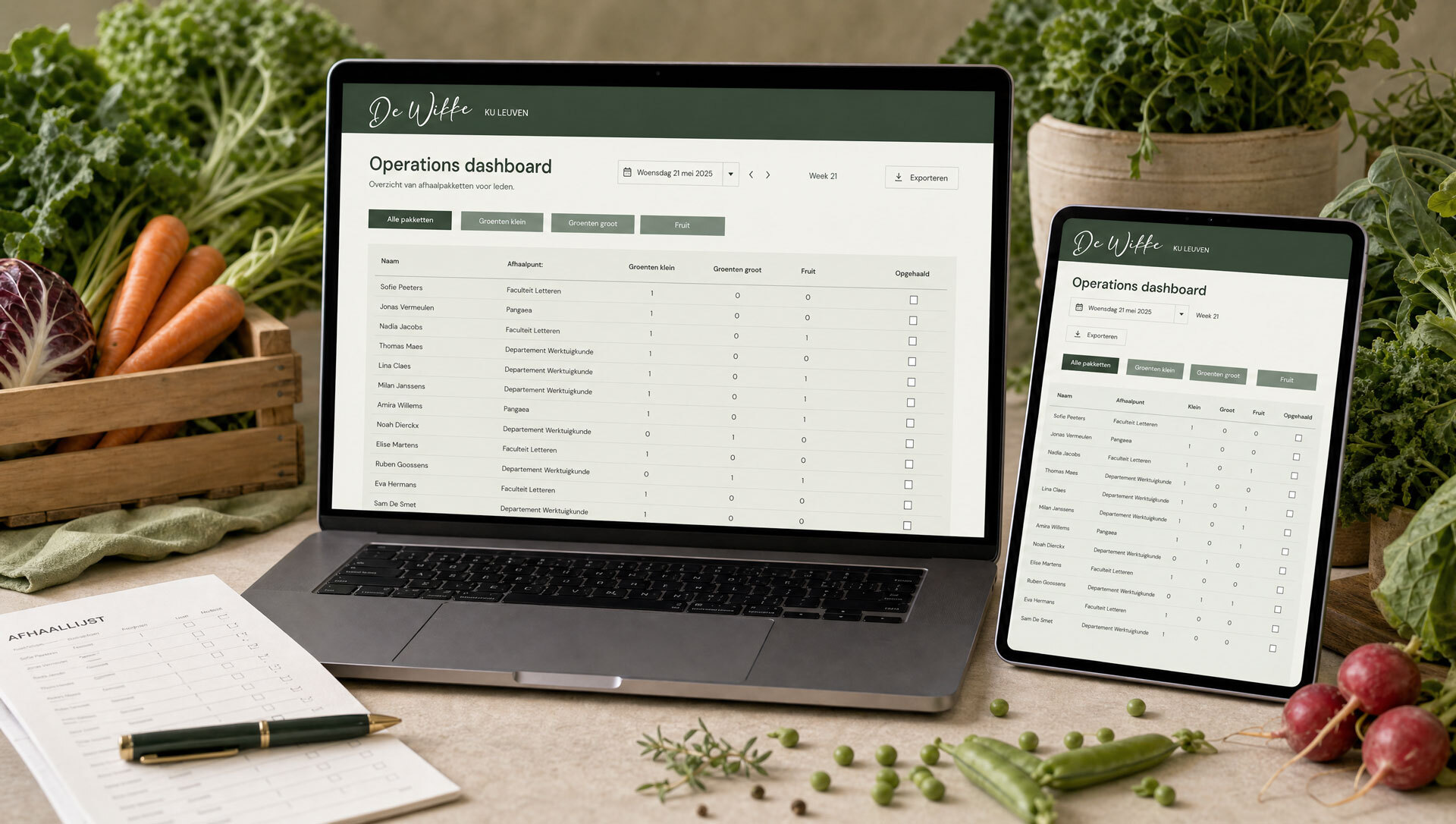
The volunteer dashboard is simple and practical. Every week the volunteer opens the dashboard and sees the pickup list for that day. Who is coming, which packages, how many of each type. At pickup, the volunteer ticks the member off.

Staff dashboard

The staff dashboard gives the same overview but across all collection points of an organisation. The De Wikke staff member can filter per collection point, see the totals, search the member list and export it.

Administrator dashboard

The administrator dashboard oversees all organisations. Member lists, registrations, payment statuses. The structure allows the operation to expand to new organisations.

Paying the way that suits you

Not every organisation works the same way. Students and staff often pay online, via Bancontact or credit card. Members joining through an organisation or department often prefer an invoice.

We integrated MultiSafepay for online payments, and for those who prefer not to pay online: an invoice option with manual follow-up. Handling exceptional cash payments is covered too.

A daily job checks seven days before the start of each period which registrations are still unpaid and automatically sends a reminder email.

Pricing and Brevo integration

Through Nimbu's Advanced Pricing system we provide the right pricing for the different types of members.

In parallel with the orders, the platform synchronises contact details with Brevo. Tags are assigned per period, so the communication team can send targeted emails. Weekly pickup reminders, recipe suggestions, seasonal information.

Project timeline

The project started in the spring of 2024. The first registration period for KU Leuven opened at the start of the academic year and the first deliveries left just a few weeks later. Given the context and the specific products (locally grown vegetable packages), the timing was fixed and tight from the outset.

That gave us just over three months from concept to go-live, in which we wanted to build in enough time for testing. The design process started with wireframes in Figma but quickly switched to iterating on working code. Thanks to good preparation and analysis, development could run at full speed over the summer. A test period was planned in August, and after feedback the platform was ready for the real test.

The result

The platform has been live since September 2024. Every period, members register themselves through the form, choose their packages and collection point, and pay online or by invoice.

Volunteers open their dashboard on Monday and immediately see who is coming by that day and which packages are ready. No more printed lists. Ticking off a pickup takes one click. The coordinator oversees everything from the staff dashboard and can pull reports per collection point or across the whole organisation.

Members manage their own subscription. Change collection point, download an invoice, adjust newsletter preferences. What used to be an email to the coordinator is now self-service.

The platform now serves several organisations. KU Leuven was the first, the City of Leuven followed. The multi-tenant architecture is built to take on new organisations without custom work. Each organisation gets its own periods, collection points, packages and management access.

After go-live the platform kept evolving. A multi-organisation enrolment flow so members can register through different organisations. Adjustments to the collection-point logic based on how volunteers and members used the platform in practice. Refined Brevo integrations. New organisations are ready to join.

Do you need a digital product that goes further than a website or app?

Tell us where your organisation wants to go and what's difficult today. We'll think along about a first workable step.

Schedule a call

You'll speak straight away with someone who digs into the actual problem.

Not ready for a conversation yet? Take a look at what we've built

Other cases

S.Tool

How we made bowel complaints after cancer surgery easier to talk about, with an app

The research team came to us with an idea and a need. No designs, no specs. They were looking for a partner who could carry the whole journey: from concept to an app in patients' hands.